

TL;DR

Get the little things that make your day delivered free — and shop member deals
- Fast, free delivery on millions of items
- Access to Prime Big Deal Days deals on October 6–7
- Prime Video, Amazon Music and more included
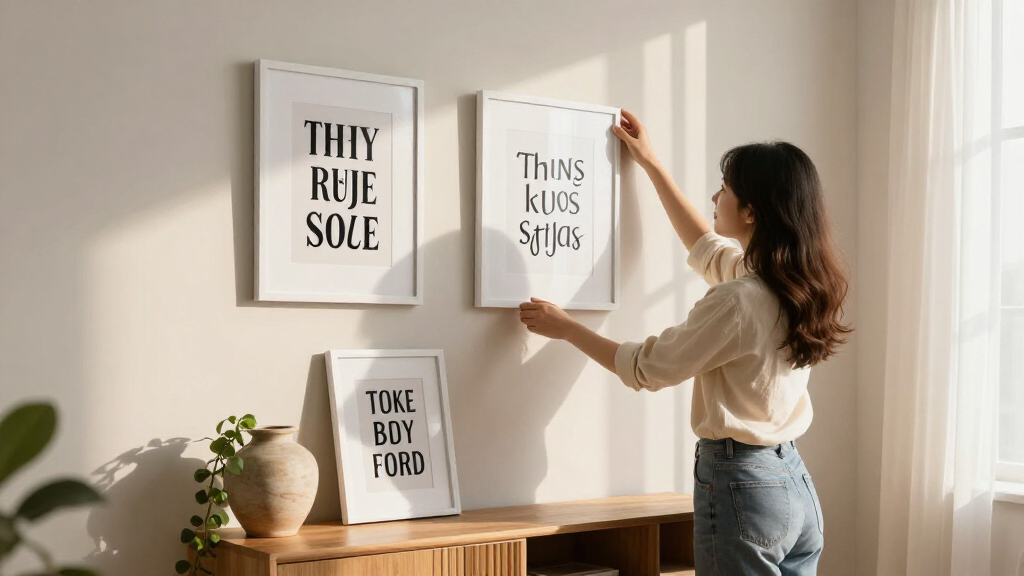
Motivational quote wall art is decorative text — prints, canvases, decals, and signs — designed to inspire, and it’s a major niche within the wall décor market. Digital downloads cost $3–$10 while framed pieces run $20–$80; the trick is matching format, size (fill 2/3 to 3/4 of your wall), and message to the right room. Notably, research shows generic positive quotes can backfire for people with low self-esteem — values-based affirmations work better.
Your friend’s home office has a black-and-white print above the desk that reads “Do it now.” You’ve glanced at it a hundred times. And every single time, you stop scrolling and get back to work. That’s the entire business case for motivational quote wall art in one anecdote.
But here’s what nobody tells you: most people buy quote art badly. Wrong size, wrong room, wrong words — a $6 printable that becomes invisible wallpaper within a week. Done right, a single well-chosen piece can anchor an entire room and actually shift your behavior.
In this guide, you’ll learn the formats worth your money, the sizing rule designers use, where to hang what, how to make your own for free, and the legal traps that catch unsuspecting Etsy sellers. Let’s get into it.
Match the message to the room: directive quotes for offices and gyms, warm or personalized pieces for bedrooms and entryways, growth-mindset quotes for kids’ s…
Use the two-thirds rule — art should span 67–75% of the wall or furniture width below it, hung at 57–60 inches to center.
Digital downloads ($3–$10) plus budget frames (IKEA RIBBA, thrifted) deliver a gallery look for under $20.
Choose quotes tied to values you actually hold — research shows generic positive statements can backfire for people with low self-esteem, while values-based af…
If you sell quote art, avoid song lyrics, movie lines, and trademarked slogans; public-domain works (authors dead 70+ years) are the safe zone.
Why Your Brain Actually Responds to Words on Walls
Motivational wall art works because repetition breeds familiarity, and familiarity shapes what psychologists call priming — the words you see daily quietly steer your attention and behavior. This matters because priming is passive: you don’t have to read the quote or agree with it. Simply having “discipline over motivation” in your field of view every morning means the idea stops being a slogan. It becomes furniture for your mind — and like furniture, you stop noticing it consciously while it still shapes how you move through the space.
But here’s the nuance most quote-sellers skip, and it changes what you should buy: the research is mixed, and the difference is who you are. Claude Steele’s self-affirmation theory, developed at Stanford, found that affirming your core values genuinely reduces stress and improves performance — the mechanism is that value-affirmation protects your sense of self-worth, so threats (a hard task, a bad day) don’t spiral. Meanwhile, a 2009 study by Wood, Perunovic and Lee found that people with low self-esteem felt worse after repeating positive statements like “I am lovable.” The implication is uncomfortable but useful: when a claim clashes with your self-image, your brain treats the gap as evidence of the opposite. “I am confident” becomes a reminder that you don’t feel confident.
Translation: choose words you half-believe, tied to values you actually hold. The tradeoff is real — aspirational quotes feel more inspiring at the point of purchase, but believable quotes do more work on your wall over time. A quote about relentless hustle hung by someone who’s burned out won’t inspire. It will accuse. That’s why a question (“What would you attempt if you couldn’t fail?”) often outperforms a command: questions invite you to answer, while commands invite you to comply — and resist.
The best motivational quote is one you’d say out loud without cringing. If it feels like a costume, it won’t work.
Every Format Compared: What $5 vs. $80 Actually Buys You
Motivational quote wall art comes in five main formats, and the price gap between them is enormous — from a $3 digital file to an $80+ framed canvas. But price isn’t really what you’re choosing between; you’re choosing between flexibility and permanence, and understanding that tradeoff is what stops you from wasting money:
| Format | Typical Price | Best For | Watch Out For |
|---|---|---|---|
| Digital download | $3–$10 | Instant décor, budget refreshes | Printing costs and sizing are on you |
| Framed print | $20–$60 | Offices, living rooms, gifts | Shipping damage on glass frames |
| Canvas | $30–$80 | Statement walls, no frame needed | Harder to swap out later |
| Vinyl decal | $8–$25 | Rented spaces, gyms, kids’ rooms | Can peel paint on removal |
| Metal / LED sign | $40–$150 | Home gyms, bold maximalist looks | Price; heavier mounting |
Here’s how to actually think about these choices. A digital download is cheap upfront, but the hidden math matters: a $5 file plus professional printing can run $10–$25, and quality varies wildly depending on the paper stock you choose — cheap office paper washes out fine serif fonts. That said, the format’s real advantage is optionality: when your motivation philosophy changes (and it will), you reprint instead of re-buying. Canvases and metal signs are the opposite trade — they look finished and gallery-grade with zero effort, but a canvas you’re tired of doesn’t get donated; it gets thrown out. Decals sit in between: cheap and low-commitment visually, but the removal risk means they’re really a renting solution, not a decorating one.
Digital downloads surged during the pandemic and never slowed down — instant, cheap, and endlessly reprintable. That staying power tells you something: the market has shifted toward treating quote art as a rotating accessory rather than a permanent fixture, which is worth mirroring in your own buying. Buy the file once, print it at any size, forever.
One budget trick: pair a $5 Etsy download with a $12 IKEA RIBBA frame or a thrift-store frame you spray-paint. Total cost under $20, and it looks like a gallery purchase. Why it works: viewers judge framing before they judge print quality — a crisp mat and clean frame make even a basic download read as intentional design.
The Sizing Rule That Makes Cheap Art Look Expensive
The single most common mistake in hanging quote art is going too small — a tiny 8×10 print floating alone on a big wall reads as an afterthought, not a design choice. And the reason this matters more for quote art than for other wall décor is specific: text needs scale to be legible and to carry emotional weight. An abstract print can be small and still set a mood; a six-word quote at postage-stamp size is just noise. Interior designers use a simple rule: art should fill about two-thirds to three-quarters of the width of the wall, or of the furniture below it.
So if your desk is 48 inches wide, your art (or gallery grouping) should span roughly 32 to 36 inches. Above a sofa, that means going big — a 24×36 print or a cluster of three 16x20s beats one lonely 11×14 every time. The psychology behind the rule: negative space around a piece frames it as deliberate, but too much space makes the piece look like it shrank in transit. The 2/3-to-3/4 range is the sweet spot where the art feels anchored to the furniture rather than lost above it.
- Measure the wall or furniture width in inches.
- Multiply by 0.67 and 0.75 — that’s your target art width range.
- Hang the center at 57 to 60 inches from the floor (eye level for the average person). Museums use this standard because art at eye level gets looked at; art hung high gets glanced past.
- For gallery walls, keep 2–3 inches between frames — even spacing is what makes a cluster read as one composition instead of several accidents.
For digital downloads, match the file’s aspect ratio to your frame — this is where most printing money gets wasted. A common frustration: printing a 16×20 file as 8×10 works (same ratio), but printing it as an 8×12 will crop your text, because 8×12 is a 2:3 ratio and the printer decides what to cut, and it won’t prioritize your words. The safe sizes — 4×5 ratios like 8×10, 16×20, and the international A-series — usually ship together in one download. The implication: before buying any file, check which ratios are included; a download that only comes in one ratio quietly limits every frame you can ever use it in.
Where to Hang What: Room-by-Room Ideas That Actually Fit
The right quote in the wrong room feels off — a hustle-culture print above your bed is a vibe mismatch. And that mismatch isn’t just aesthetic; it works against the art’s purpose. Your mental state differs by room: you enter a gym ready to be pushed, and a bedroom ready to be calmed. A quote that contradicts the room’s emotional job creates low-level friction you’ll eventually tune out entirely — which is exactly how quote art becomes invisible. Here’s where quote art genuinely earns its wall space:
- Home office — the biggest category by far, supercharged by remote work. Short, directive quotes work here because offices are where you need a nudge toward action: “Done is better than perfect.” The underlying logic: perfectionism stalls work, so a quote that legitimizes finishing fights the specific resistance you feel at a desk.
- Home gym — the fastest-growing niche post-2020. Metal or LED signs shine here: “One more rep.” Gyms tolerate — reward — aggression that would feel hostile anywhere else, and durable materials match a room where things get sweaty and hit by equipment.
- Bedrooms and nurseries — soft, calming pieces. Personalized family name prints like “The Bennetts, Est. 2020” dominate this space, and for good reason: identity-based messaging (who we are) suits rest spaces better than performance messaging (what we must do).
- Classrooms — teachers are one of the largest buyer groups. Growth-mindset quotes matter here: research from mindset studies shows emphasizing effort over ability changes how kids approach hard tasks — a child told to “keep trying” after failure persists, while one praised for talent quits. Wall text is seen daily by thirty students, making it cheap, repeated exposure to that message.
- Entryways — your home’s handshake. Warm and welcoming beats aggressive, because this is the one wall guests read, not you. Choose for your audience.
A real example: a remote marketer I know hung a single large canvas — “She believed she could, so she did” — behind her camera-facing desk. It doubled as motivation and a polished Zoom background. One purchase, two jobs — a reminder that in the remote-work era, your wall art is also your personal branding, seen by every client on every call.
Style-wise, 2024 trends favor boho neutrals (beige, terracotta), vintage serif fonts, and a return of bold maximalist typography after years of minimalism. The reason to care about trends at all: quote art is text-first décor, so it dates faster than abstract art — a font that screams “this decade” makes the message feel stale even when the words still ring true. Pick one lane per room — mixing five font styles on one wall reads as clutter, not inspiration, because the eye can’t find a hierarchy of what to read first.
Make Your Own in 20 Minutes (Free Tools Included)
You can design professional-looking quote wall art in Canva for free in about 20 minutes — no design degree required. But before the steps, understand why they matter: 90% of homemade quote art that “looks homemade” fails on three fixable things — low resolution, too many fonts, and text set too small. Fix those three and you’re indistinguishable from the Etsy listings. Here’s the exact process:
- Open Canva and search “8×10 poster” or set a custom size (2382 x 3000 pixels for crisp 8×10 printing). Resolution is non-negotiable because print shows every weakness a screen hides — a file that looks fine on your phone becomes visibly jagged on paper.
- Pick one or two fonts maximum — a bold sans-serif for the quote, an italic serif for attribution. Two fonts create contrast (statement vs. footnote); three or more create noise, because the eye reads every font change as a new piece of information to process.
- Lay out your quote at large scale: text should occupy roughly two-thirds of the canvas. Same sizing logic as hanging art on a wall — timid text in the middle of a blank page reads as a placeholder, not a statement.
- Export as PDF Print or PNG at 300 DPI — anything less will look fuzzy when printed, and there’s no fixing it after the fact; the printer can’t invent detail the file doesn’t contain.
- Upload to a print shop (FedEx, Staples, or an online service) or print at home on matte cardstock. Cardstock matters: standard printer paper is thin enough that light passes through it, and the text loses the crisp black density that makes quote art punch.
Free commercial-use fonts like Montserrat, Playfair Display, and Bebas Neue cover 90% of the styles you see on Etsy — checking the license matters even for a personal bedroom print, because “free to download” and “free to use” are different things. If you want a physical product without buying equipment, print-on-demand services like Printify or Printful will print and ship your design as a canvas or framed piece — you never touch inventory. The tradeoff: per-unit costs are higher than bulk printing, so it only makes sense for one-offs or testing designs before committing.
One caution: AI design tools make creating custom pieces absurdly easy now, but easy design doesn’t fix bad words. The bottleneck was never the typography — it was always choosing a sentence worth looking at for years. Spend more time choosing the quote than picking the font.
The Legal Line Most Etsy Sellers Cross Without Knowing
Not every quote is legal to print and sell, and this is where the motivational art business gets genuinely risky. Understanding why requires knowing what copyright actually protects. Copyright law doesn’t protect ideas or short phrases — it protects creative expression, which is why a two-word slogan is generally fair game. But song lyrics and movie lines are different: courts have repeatedly treated them as protected because they’re substantial creative expression drawn from a larger copyrighted work, and lyric prints are especially pursued because music publishers actively enforce. Designers have been sued over them. That Taylor Swift lyric print in your cart? Legally gray at best — and the risk isn’t theoretical; publishers monitor marketplaces precisely because lyric merchandise is a known revenue leak.
The safest territory is public domain: in the US, works by authors who died more than 70 years ago are generally free to use. The reason this rule exists is to balance creator compensation against cultural access — after the window closes, the work belongs to everyone. Mark Twain is safely in the public domain; Maya Angelou is not there yet, but classics are. Even Einstein quotes are complicated — the text may be usable, but his name and likeness are trademarked by his estate. This is the distinction that trips people up: copyright expires, but trademark doesn’t, as long as it’s actively enforced and commercially used. A dead author’s words can be free while a dead physicist’s face costs money.
- Generally safe: original quotes, ancient proverbs, public-domain authors, Bible verses (most translations vary — check the version, because modern translations like the NIV are copyrighted while the KJV is not).
- Risky: song lyrics, movie lines, living celebrities’ quotes, trademarked slogans (“Just Do It” is Nike’s, full stop — short phrase rules don’t override trademark, because trademark protects commercial association, not expression).
If you’re selling quote art commercially, one takedown notice can wipe out a listing — and repeat violations can end your whole shop. The asymmetry is brutal: the design took you an hour; the lawsuit risk compounds with every sale. When in doubt, write your own line.
For buyers, this matters less — hanging a lyric print in your bedroom is your business, and private display isn’t distribution. But if that little side hustle voice in your head is whispering “Etsy shop,” know the rules before you list, because “everyone else is doing it” is not a defense; it’s just evidence of how many shops are one notice away from closing.
Frequently Asked Questions
Does motivational quote wall art actually work?
It depends on the words and the person. Self-affirmation research (Claude Steele, Stanford) shows that affirmations connected to your genuine values reduce stress and improve performance. But a 2009 study by Wood, Perunovic and Lee found rote positive statements can make people with low self-esteem feel worse. Choose quotes you half-believe, tied to real goals.
What size motivational print should I buy?
Use the designer’s rule: fill two-thirds to three-quarters of your wall or the furniture below it. Above a 48-inch desk, aim for art spanning 32–36 inches — a 24×36 print or a trio of 16x20s. Hang the center 57–60 inches from the floor.
Where can I buy or download free motivational quote wall art?
Etsy dominates the market for digital downloads ($3–$10) and framed pieces ($20–$80). Amazon carries mass-market prints and decals. For free options, Pinterest and décor blogs offer printable libraries — just check the license before using anything commercially.
How do I print a digital download at the right size?
Match the aspect ratio. A 16×20 file prints cleanly at 8×10 (same 4:5 ratio), but printing it at 8×12 will crop the text. Look for downloads that include multiple sizes — 8×10, 11×14, 16×20, and A4. Export or print at 300 DPI for sharp text.
Is it legal to sell quote prints on Etsy?
Sometimes. Short phrases generally can’t be copyrighted, but song lyrics and movie lines often are, and designers have been sued over them. Public-domain works (authors dead 70+ years in the US) are generally safe, though note that Einstein’s name and likeness are trademarked by his estate. Original quotes are always your safest bet.
Conclusion
Start with one wall, one room, one quote you’d defend out loud. Pick the format that fits your budget — a $5 download is genuinely enough — apply the two-thirds sizing rule, and hang it at eye level. That single decision puts you ahead of 90% of quote art on walls today.
Because the best motivational piece isn’t the trendiest one. It’s the one you’d still want to read on a Tuesday morning when nothing is going right. What’s yours going to say?
NFL season / tailgating Picks
team gear
As an affiliate, we earn on qualifying purchases.