

TL;DR

Get the little things that make your day delivered free with Prime
- Fast, free delivery on millions of items
- Prime Video, Amazon Music and more included
- Member-only deals all year
Thorsten Meyer AI’s ISR Briefing published a July 1, 2026 analysis explaining how Wide-Area Motion Imagery watches and records movement across city-scale areas. The report says WAMI’s power lies in archived forensic tracking, while its limits include weather, airspace access, AI dependence, and legal oversight.
Thorsten Meyer AI’s ISR Briefing published a July 1, 2026 analysis of Wide-Area Motion Imagery, saying the surveillance technology can record movement across city-scale areas but depends on AI processing, radar support, and legal oversight to be useful and accountable.
The dispatch describes WAMI as a major expansion beyond ordinary full-motion video. Instead of following one narrow camera view, a WAMI payload combines many sensors into a large composite image that can show vehicles and pedestrians moving in the open across several square kilometers.
The report says the key capability is not only live viewing but archived motion history. If analysts later identify an incident, they can review recorded imagery backward, follow a mover to earlier locations, and examine where it came from or whom it met, according to the dispatch.
The analysis cites public reporting on DARPA’s ARGUS-IS, which used 368 five-megapixel cameras to create an image of about 1.8 gigapixels. The report says such systems require stabilization, mover detection, tracking, storage, and near-sensor AI because data volumes are too large for human teams to monitor manually.
The eye over the city: how Wide-Area Motion Imagery works — and where it goes blind
A normal drone sees through a soda straw. WAMI watches an entire city at once, tracks every mover, and records it all for forensic rewind. Immense reach — with hard limits that make radar and AI its necessary partners.
- City-scale motion, fine detail
- Forensic rewind
- Cloud / smoke / dark degrade it
- Needs a platform loitering overhead
sensing
+ AI
- Sees through cloud & total dark
- Tasked over denied airspace
- Persistent, wide-area from orbit
- Sovereign · on-prem · air-gap
The same archive that traces a bomber to a safe house can trace anyone home — retroactively, without prior suspicion. Baltimore’s secret 2016 deployment led to a 2021 federal ruling that persistent aerial tracking violated the Fourth Amendment. The security value is real; so is the mass-surveillance risk. Who owns the sensor, the archive, and the AI is the accountability question.
WAMI’s power is the archive and the AI reading it; its weakness is weather, airspace, and oversight. The mature posture isn’t optical-vs-radar or capability-vs-liberty — it’s layered sensing (optical WAMI + all-weather SAR), AI-enabled exploitation, and sovereign, auditable control of the whole chain. WAMI shows what a persistent eye can do with clear skies and owned airspace; for the cloud, the night, and the denied area, the radar layer is where the resilient coverage lives.
Surveillance Reach Meets Oversight Pressure
The report matters because WAMI changes the scale of aerial surveillance. A system that can record a wide area and replay movement later can help investigate bombings, shootings, border crossings, or military activity, but it can also track people who were not suspected of wrongdoing.
The dispatch points to the 2016 Baltimore deployment and a 2021 federal appeals ruling as evidence that the legal questions are no longer theoretical. According to the report, the central accountability issue is who controls the sensor, archive, AI models, and access rules.
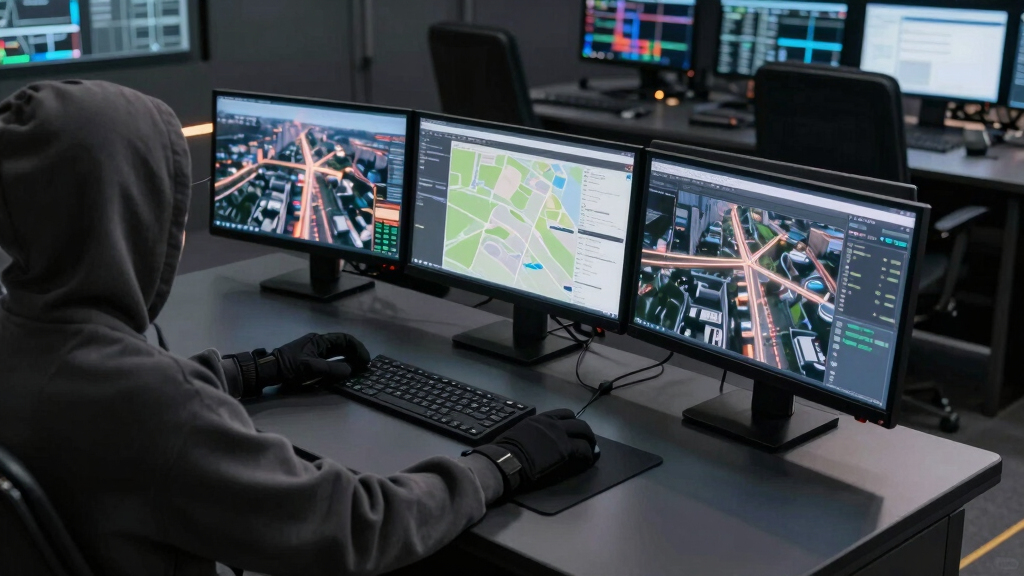
wide-area motion imagery surveillance system
As an affiliate, we earn on qualifying purchases.
As an affiliate, we earn on qualifying purchases.
From Drone Video to City Archive
BAE Systems describes WAMI as an airborne optical ISR approach that combines sensors, cameras, and processors to detect and track movement across a large area. The dispatch says RUSI analysts have described WAMI’s coverage as much larger than conventional full-motion video and tied it to a real-time forensic capability.
The July 1 analysis also says WAMI has physical limits. Cloud, smoke, darkness, and airspace restrictions can reduce or block optical collection. For that reason, the report argues that synthetic aperture radar can fill gaps because radar can operate through cloud and at night, including from spaceborne platforms.
“A normal drone sees through a soda straw. WAMI watches an entire city at once.”
— Thorsten Meyer AI’s ISR Briefing
high-resolution city surveillance camera
As an affiliate, we earn on qualifying purchases.
As an affiliate, we earn on qualifying purchases.
Limits Still Need Hard Answers
The dispatch does not establish how current operators set retention periods, access controls, audit logs, or AI review standards across all WAMI deployments. It is also not clear from the source material how widely comparable systems are in active use today outside publicly reported programs.
The report argues that radar and optical WAMI should be layered, but performance will vary by platform, mission, weather, sensor quality, and legal authority. Details on specific operational deployments remain limited in the public record.
As an affiliate, we earn on qualifying purchases.
Policy Will Follow the Sensors
The next issue is whether governments and vendors can define rules before wider deployment of persistent aerial surveillance. The dispatch says mature use would require layered sensing, AI-enabled analysis, and sovereign, auditable control over collection and archives.
Courts, procurement agencies, and defense users are likely to face more questions about warrants, retention, model accountability, and public disclosure as WAMI and radar-backed surveillance systems become more capable.
As an affiliate, we earn on qualifying purchases.
Key Questions
What is the actual news development?
Thorsten Meyer AI’s ISR Briefing published a July 1, 2026 analysis explaining how Wide-Area Motion Imagery works, where it has limits, and why oversight remains contested.
What does WAMI do?
WAMI uses large camera arrays to monitor movement across a city-scale area. The report says its archive lets analysts review movement backward after an incident.
What is confirmed and what is claimed?
The source confirms the report’s publication and cites known public examples such as ARGUS-IS and the Baltimore ruling. Broader judgments about the best operating model for WAMI are the dispatch’s analysis.
Why does AI matter for WAMI?
The dispatch says AI is needed because WAMI produces too much imagery for human teams to monitor live or for systems to transmit in full from the platform.
Why is WAMI controversial?
The same archive that can help investigators trace an incident can also support retrospective tracking of people without prior suspicion, raising privacy and Fourth Amendment concerns in the United States.
Source: Thorsten Meyer AI
NFL season / tailgating Picks
team gear
As an affiliate, we earn on qualifying purchases.