
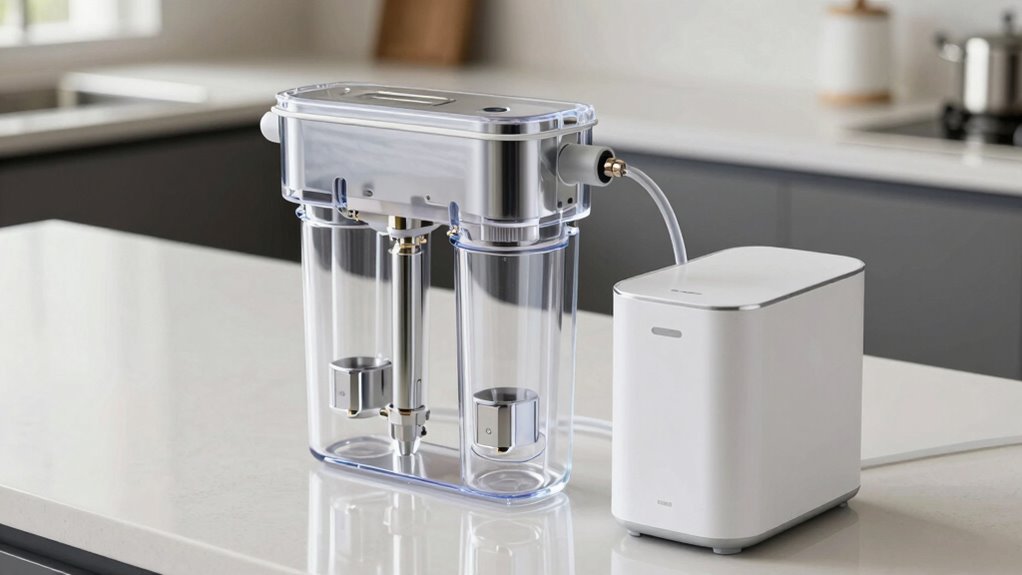

If your water has high pollutants and you want thorough purification, upgrading to a reverse osmosis (RO) system makes sense, though it’s more costly and requires professional installation. If your water quality is decent and you’re mainly concerned with taste, odors, or convenience, a countertop filter is a budget-friendly, easy-to-install option. Both improve water quality, but your choice depends on your specific needs and space. Keep exploring to find the right fit for you.
Key Takeaways
- Choose an RO system for comprehensive removal of heavy metals, chemicals, and high pollutant levels; opt for a countertop filter for basic taste and odor improvement.
- Install an RO system if you have space, budget, and willingness for professional setup; select a countertop filter for easy, DIY installation.
- Prioritize an RO system for households with serious water contamination; use a countertop filter for mild issues and convenience.
- Consider long-term costs and maintenance complexity: RO systems are more expensive and involve regular filter changes; countertop filters are simpler and budget-friendly.
- Assess your water quality, space, and lifestyle to determine if a thorough purification system or a portable, easy-to-maintain filter suits your needs better.
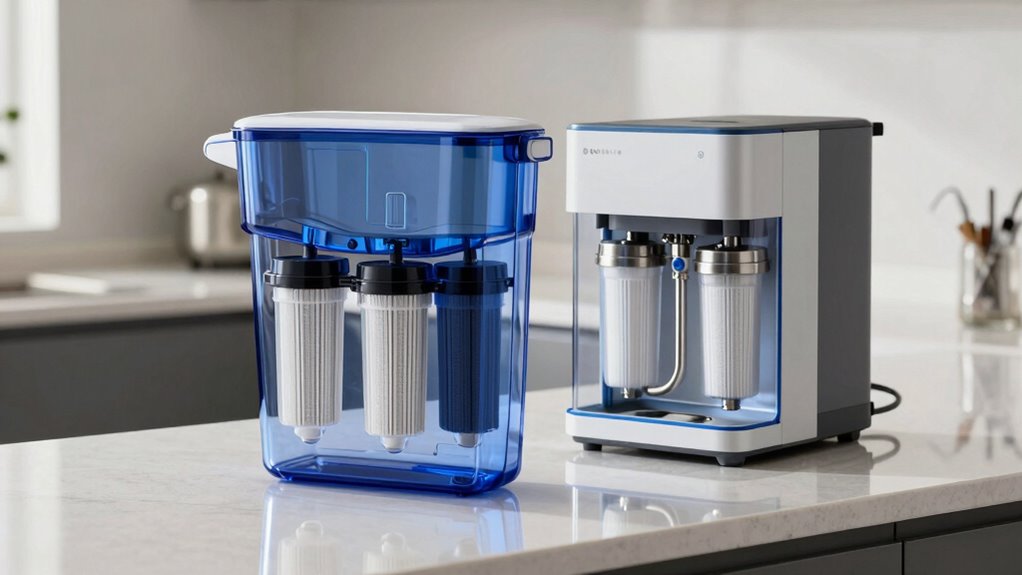
When choosing a water filtration system, understanding the differences between a reverse osmosis (RO) system and a countertop filter can help you make an informed decision. Both options aim to improve your water quality, but they do so in different ways and with varying installation processes. Knowing how each system handles water purification and what’s involved in setting them up will guide you toward the best fit for your needs.
Understanding the differences between reverse osmosis and countertop filters helps you choose the best water purification solution.
A reverse osmosis system is designed for thorough water purification. It uses a semi-permeable membrane to remove contaminants like heavy metals, chemicals, and dissolved solids. This process produces cleaner, better-tasting water and is ideal if you’re concerned about high levels of pollutants in your tap water. However, installing an RO system involves more steps. Typically, you’ll need to connect it under your sink or in your basement, which might require some plumbing work. The setup often includes a dedicated faucet and a storage tank, making the installation process more involved and sometimes requiring professional help. Once installed, the system provides reliable, high-quality filtration, but it’s also more maintenance-heavy, needing regular filter changes and occasional system flushing.
On the other hand, countertop filters are much simpler to install. They usually sit directly on your counter and connect easily to your faucet with minimal effort. You don’t need to manipulate plumbing or install additional fixtures. The water purification process in countertop filters varies depending on the model, but many use activated carbon to effectively remove chlorine, sediments, and certain chemicals. They’re excellent for improving taste and odor, especially if your tap water isn’t heavily contaminated. Because they’re portable and easy to set up, countertop filters are convenient for renters or those who prefer a straightforward solution. Maintenance is generally simpler too; you’ll replace cartridges periodically without the need for complex procedures or tools.
Choosing between these two options depends on your water quality concerns and your willingness to handle installation. If your water has significant contaminants and you want the highest level of purification, an RO system might justify the extra effort and cost. If you’re looking for quick, easy improvements to taste and odor, a countertop filter could be enough. Consider how much space you have, your budget, and whether you’re comfortable with installation tasks. Both systems can dramatically improve your water quality, but the right choice hinges on your specific needs, preferences, and lifestyle.

iSpring RCC7AK-BN NSF Certified, 75 GPD, Alkaline 6-Stage Reverse Osmosis System, pH+ Remineralization RO Water Filter System Under Sink Patented Top-Mounted Faucet Design for Easy Installation
- Patented Top-Mounted Faucet Design: Easy above-sink installation
- Mineral Boost Stage: Adds essential minerals and pH balance
- Transparent Filter Housing: Monitor contaminant buildup easily
As an affiliate, we earn on qualifying purchases.
As an affiliate, we earn on qualifying purchases.
Frequently Asked Questions
How Long Does Installation Typically Take for Each System?
The installation process for a countertop filter usually takes about 10 to 30 minutes, making it quick and straightforward. In contrast, setting up a reverse osmosis system can take 1 to 3 hours because it involves more parts and plumbing. You’ll need to carefully follow instructions for the system setup, especially for the RO unit, to make certain everything is properly connected and functioning correctly.
Are There Any Maintenance Differences Between the Two?
You’ll find that maintenance complexity varies, with countertop filters usually requiring less effort and simpler upkeep, like changing filters every few months. Reverse osmosis systems involve more maintenance, including cleaning and replacing multiple filters and the RO membrane periodically, which can increase cost implications. While both need regular attention, an RO system’s maintenance is more involved, so consider your willingness to handle the upkeep when choosing between the two.
Which System Is More Environmentally Friendly?
The countertop filter is generally more eco-friendly because it uses less water and energy, promoting better water conservation and eco-friendly practices. Reverse osmosis systems tend to waste more water during filtration, which impacts environmental sustainability. If reducing water waste and conserving resources are your priorities, a countertop filter makes a better choice. It’s simpler, uses fewer resources, and supports your efforts to live more sustainably.
Can Both Systems Remove Heavy Metals Effectively?
You wonder if both systems can effectively remove heavy metals, and the answer is yes, but with differences. Reverse osmosis systems excel in heavy metal removal due to their high filtration efficiency, trapping even microscopic contaminants. Countertop filters may struggle with certain heavy metals unless specially designed. Visualize a powerful, fine-mesh net catching tiny particles—RO systems act like that net, providing peace of mind for safer drinking water.
What Is the Typical Lifespan of Each Filter?
You can expect the typical lifespan of a reverse osmosis (RO) system filter to be about 6 to 12 months, depending on usage and water quality, with regular replacement ensuring peak filter durability. Countertop filters generally last 2 to 6 months before needing replacement. Regularly monitoring and changing filters is essential for maintaining filtration efficiency and ensuring your water stays clean and safe.
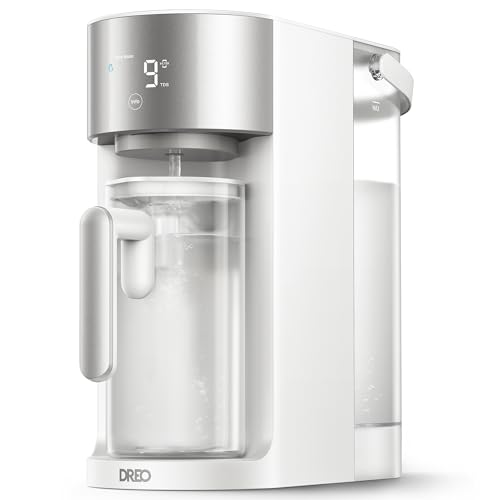
DREO Reverse Osmosis Water Filter Countertop, RO Filtration System, 3:1 Pure to Drain, TDS & Filter Life & Autofill Pitcher, Installation-Free, Self-Cleaning Water Purifier, RO Water Filter
- SGS Tested for Impurity Removal: Removes 1000+ impurities including chemicals
- Real-Time TDS & Filter Monitoring: Displays raw and pure water TDS levels
- Auto-Fill and Self-Cleaning System: Hands-free refills and automatic internal cleaning
As an affiliate, we earn on qualifying purchases.
As an affiliate, we earn on qualifying purchases.
Conclusion
Choosing between a reverse osmosis system and a countertop filter is like picking the right tool for a job—you want what fits your needs best. If you’re after pure, crystal-clear water and don’t mind a bigger setup, the reverse osmosis system is your sturdy, reliable ship. But if you prefer quick, easy upgrades on a budget, a countertop filter is your trusty canoe—simple, portable, and effective. Either way, you’re steering toward better-tasting water.
iSpring RCC7AK-BN NSF Certified, 75 GPD, Alkaline 6-Stage Reverse Osmosis System, pH+ Remineralization RO Water Filter System Under Sink Patented Top-Mounted Faucet Design for Easy Installation
- Patented Top-Mounted Faucet Design: Easy above-sink installation
- Mineral Boost Stage: Adds essential minerals and pH balance
- Transparent Filter Housing: Monitor contaminant buildup easily
As an affiliate, we earn on qualifying purchases.
As an affiliate, we earn on qualifying purchases.

Aigerri Countertop Reverse Osmosis Water Filter, 5-Stage RO Water Filtration System with UV, 5:1 Pure-to-Drain Ratio, No Installation Required, Portable Water Purifier for Home, Kitchen, Office & RV
- Large 5L Water Tank: Includes 5L feed and 2L purified tanks
- High Capacity Filtration: Purifies up to 529 gallons of water
- Efficient Water Use: 5:1 pure-to-drain ratio reduces waste
As an affiliate, we earn on qualifying purchases.
As an affiliate, we earn on qualifying purchases.